ITO vs. FTO: Which to Choose? A Comprehensive Guide to Avoid Mistakes!
FTO (Fluorine-Doped Tin Oxide): The High-Temperature Resistant "King of Resistance"
Heat Resistance: MAX! Withstands sintering at 500-600°C while maintaining rock-solid conductivity.
Surface Texture: Relatively rough (high haze), with a "mountain-like" surface. While this texture is coarse, it actually increases light scattering and light-harvesting ability for thicker mesoporous layers.
Chemical Properties: Extremely stable, resistant to acids and alkalis, and not easily degraded in the atmosphere.
Cost-Effectiveness: Common raw materials, affordable price, the first choice for mass production.
ITO (Indium Tin Oxide): The Delicate "Conductive Gem"
Heat Resistance: Average. Above 300-400°C, resistivity spikes dramatically, and the conductive layer is prone to failure.
Surface Texture: Extremely smooth (low roughness), excellent light transmittance (visible light + near-infrared transmittance >90%).
Conductivity: High electron mobility, superior conductivity to FTO at the same thickness.
Flexibility: Standard for flexible substrates (PET/PEN-ITO).
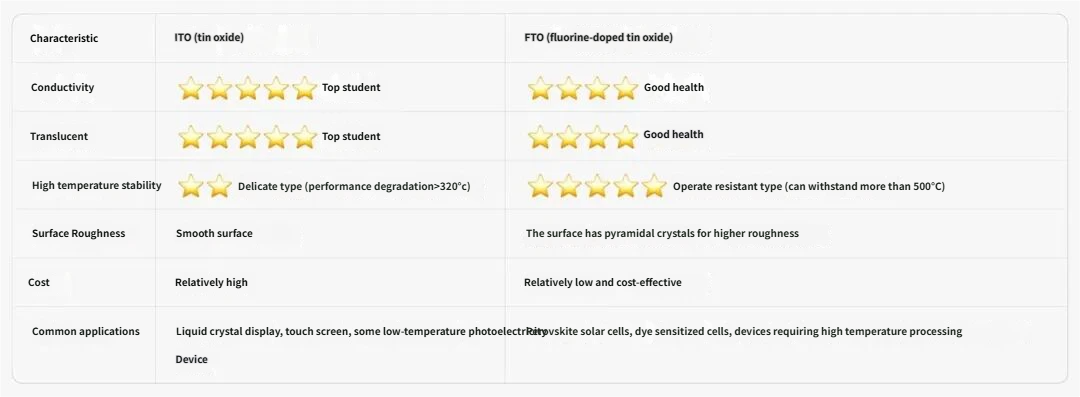
A Guide to Choosing Glass for Different Structures
Situations where FTO is the only option:
Your process involves high temperatures (e.g., sintering or annealing at >350℃)! • Typical example: The titanium dioxide electron transport layer in perovskite solar cells requires sintering at around 500℃; FTO is the only and necessary choice. Using ITO? It's ruined after sintering, and conductivity plummets. • In short: If your process involves high temperatures, FTO is your "chosen one." For low-cost mass production: FTO is inexpensive and has good chemical stability, suitable for long-term outdoor use.
Situations where ITO can be considered:
Your process involves low/room temperatures throughout and has extremely high requirements for conductivity and light transmittance! • Typical scenarios: Flexible electronics, some OLED bottom electrodes, and optical devices with extremely high surface flatness requirements. In short: No high-temperature steps, pursuing the ultimate electrical and optical properties.




 Wechat
 WhatsApp
 E-Mail